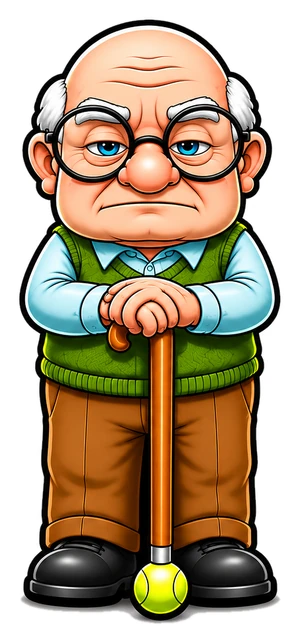
The legend of Mr. Stickers
Every great company has an origin story. Ours involves a lunchbox, a hailstorm, a tennis ball, and a man who has been described by his own doctor as “mostly adhesive.”
Chapter 1: Born sticky
Mr. Stickers was born on a Tuesday, which he still resents. The nurses tried to hand him to his mother, but he wouldn’t let go of the clipboard. Not because he was strong. Because he was sticky. Nobody has ever explained it, and he has never asked. “Some babies are born with a full head of hair,” his mother said. “Ours came out with a peel-off backing.”
By age six he had labelled every object in the house. The fridge said FRIDGE. The cat said NOT A HAT. His father’s car said HONK IF YOU’RE LATE FOR SUPPER, which caused a series of misunderstandings on the highway that the family still doesn’t discuss at Christmas.
Chapter 2: The lunchbox incident
In grade four, young Stickers traded his entire collection of scratch-and-sniff stickers for a single metal lunchbox. It was the worst trade in schoolyard history. The lunchbox was dented, smelled faintly of egg salad, and had a picture of a horse on it that looked like it had lost an argument.
So he covered it. Every inch. Planets, lightning bolts, a smiling hot dog, and one sticker that just said NO. By lunchtime the next day, half the class wanted their lunchboxes done. By Friday he was running a waiting list. By the end of the month the principal called his parents in, not because he was in trouble, but because the principal wanted his filing cabinet done and didn’t know how to ask.
That was the day he learned the two great truths of his life: people love stickers, and nobody likes a boring lunchbox.
Chapter 3: The glasses
You may have noticed his glasses. They are large. They are round. They have been described as “two satellite dishes having a meeting.” He got them at fourteen after spending an entire summer trying to peel the backing off a sticker that, it turned out, didn’t have a backing. It was a coin. It was stuck to the sidewalk. It was 1962 and the coin was worth eleven cents, and he never got it off.
The optometrist told him he needed glasses. He told the optometrist he needed a sticker that said I NEED GLASSES. They were both right.
Chapter 4: The sweater vest years
Mr. Stickers spent the next forty years doing what he loved: sticking things to other things. Bumper stickers for farmers who wanted the whole highway to know how they felt about the weather. Labels for jam that won ribbons at county fairs. A hand-cut decal for a hockey team that went on to lose every game that season, which he maintains had nothing to do with the decal.
He wore the same green sweater vest through all of it. Not the same style. The same vest. He has had it re-knitted eleven times. His wife says it’s “less a garment and more a lifestyle.” He says it has pockets for a reason, and the reason is stickers.
Chapter 5: The cane and the tennis ball
People ask about the tennis ball on the end of his cane. The official story is that it stops the cane from slipping. The real story is that in 1987 he lost a game of doubles so badly that he swore he would carry the ball with him until he got revenge. His opponent moved to Florida in 1991. The ball stays. “He’ll be back,” says Mr. Stickers. “They always come back for the stickers.”
Chapter 6: The umbrella
Mr. Stickers will tell anyone who asks, and many who don’t, that he has never once been rained on. This is because he does not get caught in the rain. He gets caught in paint. Everywhere he goes, colour seems to follow, dripping off signs, splashing off windows, raining down from nowhere in particular. Scientists can’t explain it. His dry cleaner has stopped trying.
So he carries an umbrella. It has never kept him clean. It does, however, look fantastic.
Chapter 7: Retirement (attempted)
At some point the family convinced Mr. Stickers to retire. He lasted four days. On day one he labelled the spice rack. On day two he labelled the labels. On day three he discovered the internet and learned that young people were paying good money for stickers to put on laptops, water bottles and something called “a Stanley.” On day four he was found in the garage at 3 a.m. trying to feed a roll of vinyl into the toaster.
On day five he cashed in the savings bonds his grandmother gave him in 1951 and bought himself a proper printer. A big one. The kind that prints on vinyl, canvas, banners and window film, and cuts out whatever shape you can dream up. He looked at it for a long time. Then he put a sticker on it that said MINE. The family stopped suggesting retirement.
Chapter 8: Today
These days Mr. Stickers checks every order himself. He sits in his chair, squints at your artwork through those enormous glasses, and says things like “back in my day we cut these with our teeth.” Then he prints it, laminates it, cuts it and sends you a proof. He still types emails with one finger, but they always get there.
He’s grumpy. He’s slow on stairs. He thinks Wi-Fi is a type of cheese. But he knows a good sticker when he sees one, and he won’t let a bad one leave the building.
The (slightly) more serious part
Mr. Stickers Corp. is a small Canadian print shop. Mr. Stickers prints custom stickers, canvas prints, banners and window graphics in-house on his own HP Latex printer, laminates them, and finishes every order by hand. Every order gets a free proof, and nothing prints until you approve it.
He doesn’t drop-ship. He doesn’t outsource. He doesn’t press a button that wakes up a giant machine on the other side of the planet. So if your stickers don’t land on your doorstep tomorrow morning, it’s because a four-foot-six man with a cane is still laminating them, one at a time, while humming something from 1958. He’s aware some companies are faster. He has a hearing aid with a special setting that filters out the words “is it done yet.” Quality takes time. So does the walk to the post office.
He’s not the biggest sticker company out there, and he doesn’t want to be the cheapest. He wants to be the one you tell your friends about: the one who caught the typo, answered the email, and made the sticker that’s still on your truck five years later.
He prints it. You stick it. He complains about it. Everybody wins.